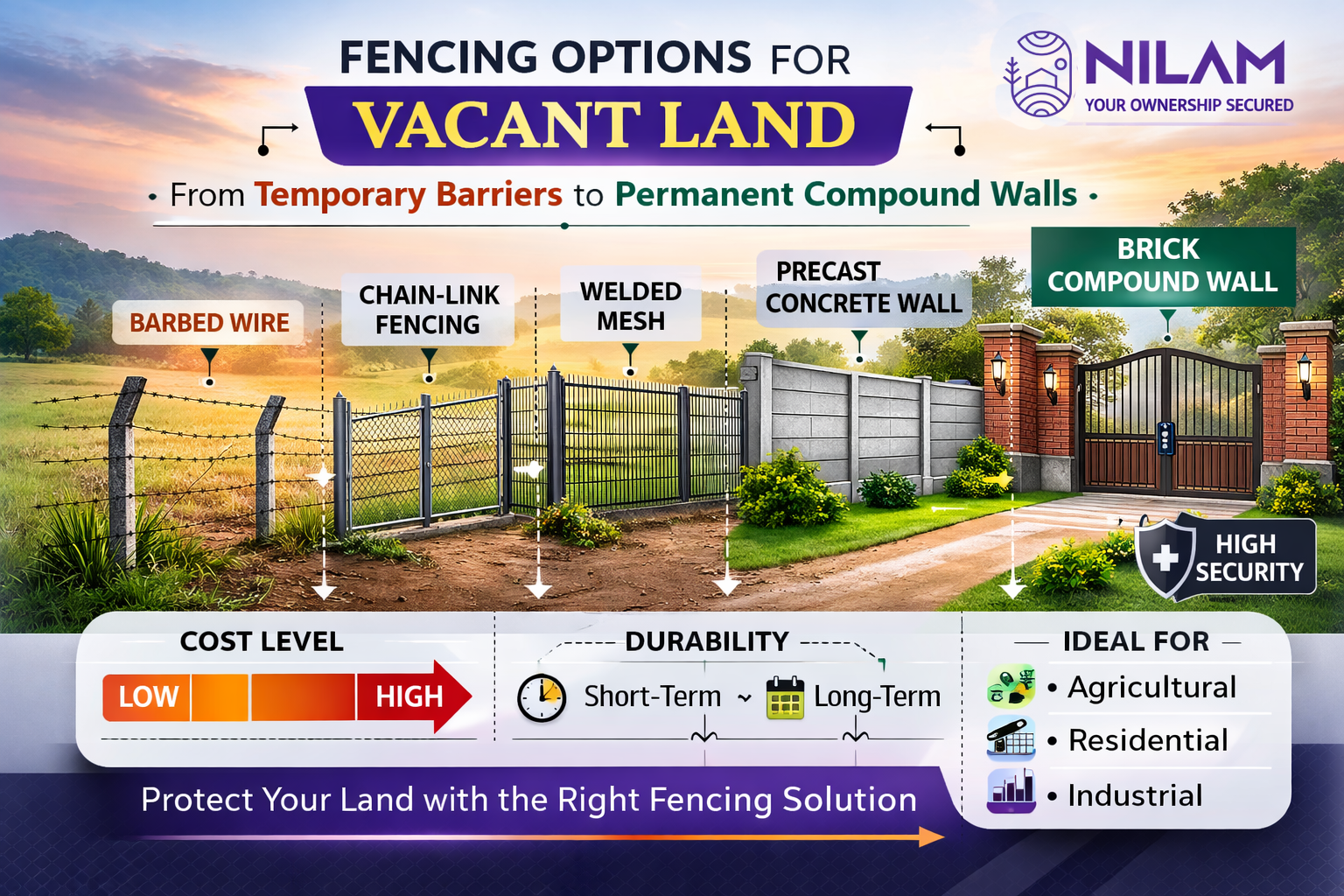
Fencing Options for Vacant Land: From Temporary Barriers to Permanent Compound Walls
Fencing for vacant land can range from temporary barriers to permanent compound walls. Analysing the type of fencing required for a specific land parcel depends on several factors such as location, terrain, surrounding development, accessibility, and the level of security needed.
Each plot is unique and choosing the wrong fencing solution can lead to ineffective protection, higher maintenance or unnecessary future expenses. Therefore, determining the most suitable fencing option requires professional expertise and careful evaluation.
Factors That Influence the Right Fencing Choice
Selecting the right fencing solution is not only about cost. It also depends on the actual condition and future purpose of the land.
- Location of the land parcel
- Terrain and soil condition
- Surrounding development
- Accessibility to the site
- Risk of encroachment
- Boundary measurements
- Nearby infrastructure
- Long-term land use plans
- Required level of security
A professional assessment typically considers all these aspects before recommending whether the land needs temporary boundary fencing, semi-permanent security fencing or a permanent compound wall.
This helps ensure that the fencing solution not only protects the property but also aligns with the owner’s long-term development plans.
Comparison of Common Fencing Types
Below is a comparison of different fencing types based on cost level, durability, security level and typical use.
| S. No | Fencing Type | Description | Cost Level | Durability | Security Level | When to Install / Typical Use |
|---|---|---|---|---|---|---|
| 1 | Barbed Wire Fencing | Steel wires with sharp barbs fixed between metal or concrete posts | Low | Medium | Basic | Immediately after purchasing land; suitable for agricultural land or plots left unused for a few years |
| 2 | Bamboo / Wooden Fencing | Bamboo or wooden poles arranged around the boundary | Low-Medium | Low | Very Basic | Short-term protection in rural areas or temporary boundaries |
| 3 | Chain-Link Fencing | Galvanized steel wires woven into a diamond mesh and attached to posts | Medium | High | Moderate | Vacant plots or industrial sites needing moderate security |
| 4 | Welded Wire / Mesh Fencing | Welded metal mesh panels fixed between posts | Medium | Medium-High | Moderate | Residential plots needing stronger protection than basic fencing |
| 5 | Precast Concrete Panel Wall | Reinforced concrete panels installed between concrete posts | High | High | High | When land development is planned or long-term security is required |
| 6 | Brick / Stone Compound Wall | Masonry wall built using brick, stone or reinforced concrete | Very High | Very High | Very High | Permanent protection for residential or commercial development |
Why Professional Evaluation Matters
Choosing a fencing option without proper site evaluation can result in poor protection, frequent repairs or unnecessary spending later. A professional review helps landowners make informed decisions based on the actual condition of the land.
Experts can recommend the most suitable fencing solution by studying the land’s characteristics, risk factors and long-term requirements. This reduces trial and error and supports better planning.
How Nilam Insights Supports Landowners
In this context, Nilam Insights plays an important role in assisting landowners with informed decisions and reliable services. Nilam Insights provides professional guidance in selecting the most appropriate fencing solution based on the land’s characteristics and the owner’s requirements.
This expertise helps landowners avoid trial-and-error approaches and ensures that the chosen fencing method provides effective protection, durability and long-term value.
With the right combination of technical knowledge, field expertise and ongoing monitoring, Nilam Insights enables landowners to safeguard their land while ensuring that the property remains well maintained and protected for future development.