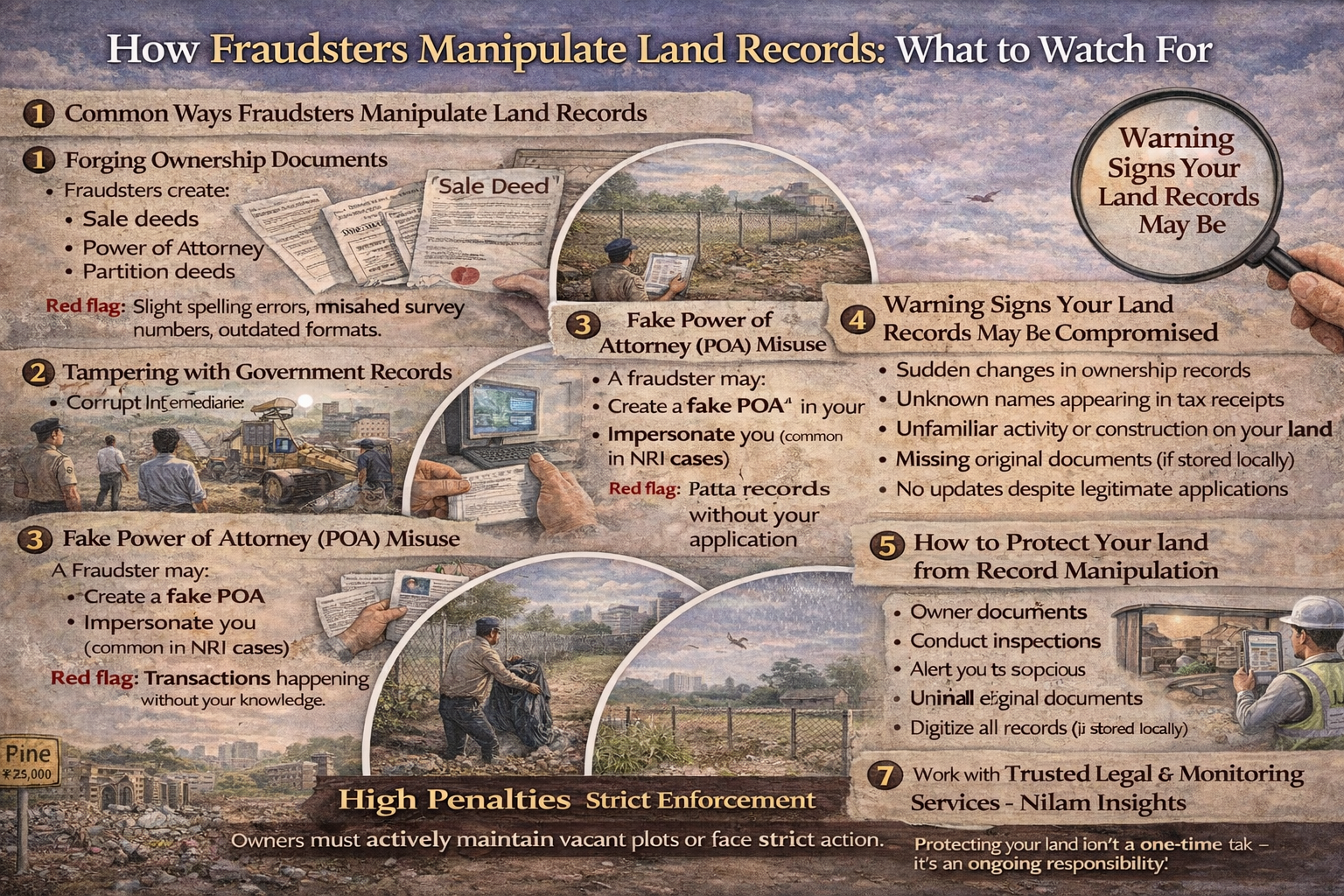
How Fraudsters Manipulate Land Records: What to Watch For
Land fraud is one of the most dangerous risks for property owners in India—especially for NRIs and absentee landholders. With increasing digitization, scams have become more sophisticated, combining document forgery, identity theft, and system loopholes to illegally claim ownership or sell land.
Understanding how fraudsters operate is the first step to protecting your property.
Common Ways Fraudsters Manipulate Land Records
1. Forging Ownership Documents
Fraudsters create fake:
- ✅ Sale deeds
- ✅ Power of Attorney (POA) documents
- ✅ Partition deeds
They may replicate seals, signatures, and even registration formats to make documents look authentic.
Red flag: Slight spelling errors, mismatched survey numbers, or outdated formats.
2. Tampering with Government Records
Despite digitization, local records can sometimes be manipulated through:
- ✅ Corrupt intermediaries
- ✅ Unauthorized changes in land registry entries
- ✅ Fake mutation updates
Red flag: Your name suddenly missing or replaced in official land records.
3. Fake Power of Attorney (POA) Misuse
A fraudster may:
- ✅ Create a fake POA in your name
- ✅ Impersonate you (common in NRI cases)
- ✅ Sell the land to a third party
Red flag: Transactions happening without your knowledge.
4. Illegal Mutation (Patta Transfer)
Mutation (Patta transfer) is often exploited to establish "ownership" on paper. Fraudsters:
- ✅ Submit fake documents
- ✅ Bribe officials to approve transfer
- ✅ Change revenue records quietly
Red flag: Patta records updated without your application.
5. Identity Theft
Using stolen or fabricated identity proofs, fraudsters:
- ✅ Pose as the landowner
- ✅ Execute sale transactions
- ✅ Register property in someone else's name
Red flag: Unknown persons claiming authority over your land.
6. Boundary Manipulation
This involves:
- ✅ Shifting boundary markers
- ✅ Altering survey sketches
- ✅ Encroaching gradually
Red flag: Missing or moved boundary stones, new fencing lines.
7. Double Registration / Multiple Sales
Fraudsters sell the same land to multiple buyers using:
- ✅ Duplicate documents
- ✅ Different registration offices
- ✅ Backdated agreements
Red flag: Multiple parties claiming ownership.
Warning Signs Your Land Records May Be Compromised
Watch for these early indicators:
- ✅ Sudden changes in ownership records
- ✅ Unknown names appearing in tax receipts
- ✅ Unfamiliar activity or construction on your land
- ✅ Missing original documents (if stored locally)
- ✅ No updates despite legitimate applications
- ✅ Discrepancies between physical land and records
How to Protect Your Land from Record Manipulation
1. Regularly Verify Land Records Online
- ✅ Ownership details
- ✅ Patta status
- ✅ Encumbrance certificate
Make this a routine—even if nothing seems wrong.
2. Secure Your Original Documents
- ✅ Store in a bank locker
- ✅ Keep notarized copies
- ✅ Digitize all records
3. Use Geo-Tagged Documentation
Maintain:
- ✅ Time-stamped photos
- ✅ Video records of your land
- ✅ Inspection reports
These act as strong legal evidence.
4. Monitor Your Land Periodically
Regular inspections help detect:
- ✅ Boundary changes
- ✅ Unauthorized activity
- ✅ Early encroachment signs
5. Limit Power of Attorney Risks
- ✅ Avoid giving broad POA powers
- ✅ Use registered and time-bound POA
- ✅ Revoke unused POAs immediately
6. Install Physical Safeguards
- ✅ Fencing or compound walls
- ✅ Boundary stones with markings
- ✅ Warning signboards
7. Work with Trusted Legal & Monitoring Services — Nilam Insights
- ✅ Verify documents
- ✅ Conduct inspections
- ✅ Alert you to suspicious changes
- ✅ Wide range of technology enabled services in protection of land
Pro Tip for NRIs & Absentee Owners
Fraudsters specifically target vacant, unmonitored land. The longer a property stays unchecked, the easier it becomes to manipulate records and create "legal-looking" ownership trails.
Final Thoughts
Land record fraud is no longer rare—it's evolving. From fake documents to digital manipulation, the risks are real and growing.
The best defence is a combination of:
- ✅ Awareness
- ✅ Regular monitoring
- ✅ Strong documentation
- ✅ Quick legal action
Protecting your land isn't a one-time task—it's an ongoing responsibility and Nilam Insights makes it easier.