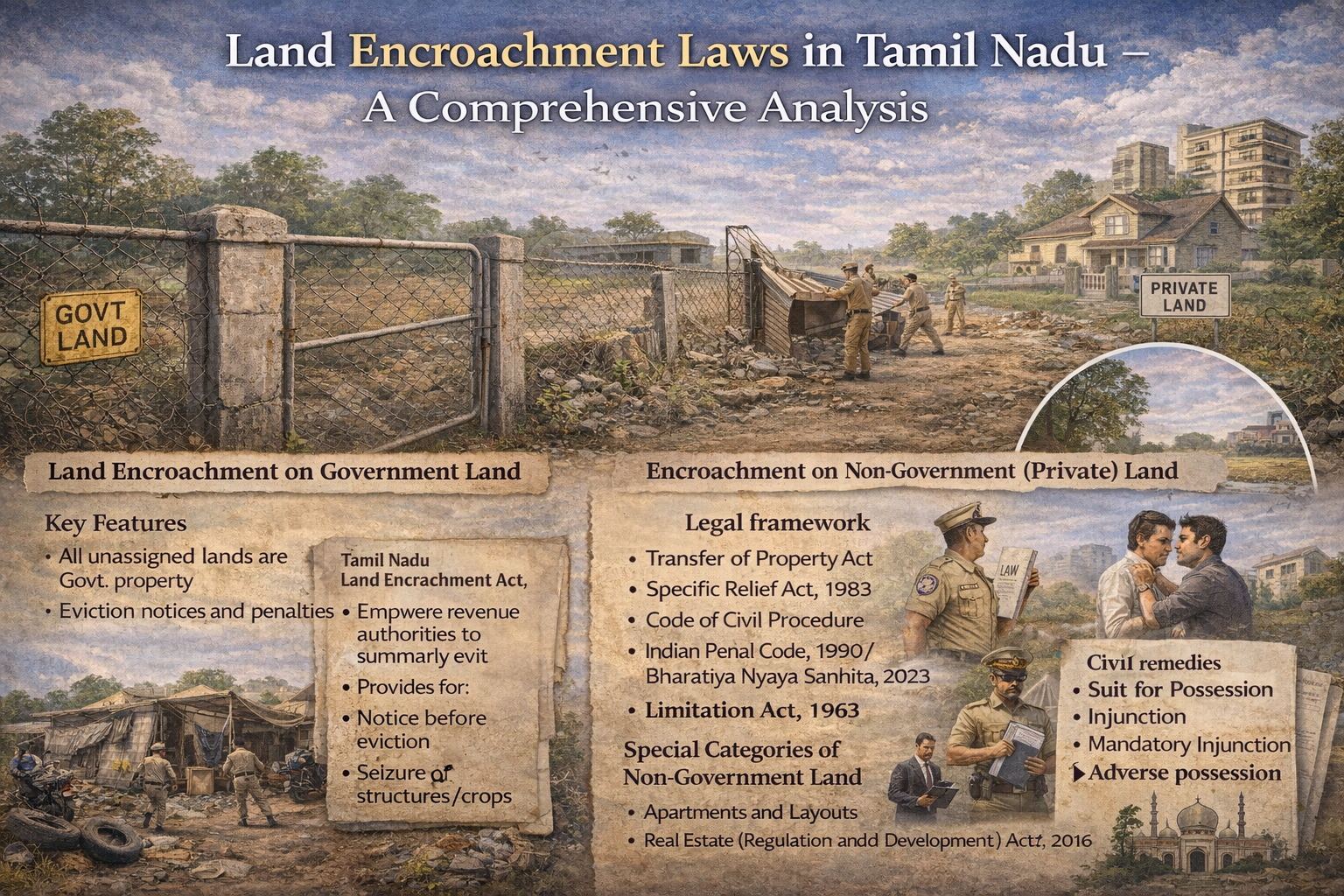
Land Encroachment Laws in Tamil Nadu – A Comprehensive Analysis
Introduction
Land encroachment refers to unauthorised occupation of land, either belonging to the government or private individuals. Tamil Nadu follows a dual legal framework—a strong administrative system for government land and a judicial system for private land.
I. Encroachment on Government Land
1. Core Law
The principal statute is the Tamil Nadu Land Encroachment Act, 1905.
Key Features
- ✅ Declares all unassigned lands as Government property
- ✅ Empowers revenue authorities to summarily evict encroachers
- ✅ Provides for: Notice before eviction, Levy of penal assessment, Seizure of structures/crops
- ✅ Payment of penalty does not confer ownership
Nature: Administrative and summary (no prolonged court process)
2. Sector-Specific State Laws
Tamil Nadu supplements the 1905 Act with special laws:
- ✅ Tamil Nadu Public Premises (Eviction of Unauthorised Occupants) Act, 1975 – public buildings
- ✅ Tamil Nadu Highways Act, 2001 – roads and highways
- ✅ Tamil Nadu Panchayats Act, 1994 – village commons
- ✅ Tamil Nadu Protection of Tanks and Eviction of Encroachment Act, 2007 – water bodies
This reflects a multi-layered statutory framework.
3. Enforcement Mechanism
- ✅ Detection by revenue officials
- ✅ Issue of notice
- ✅ Passing of eviction order
- ✅ Physical removal with police support
Judicial Role
The Madras High Court has:
- ✅ Directed time-bound eviction drives
- ✅ Strengthened enforcement, especially for water bodies and public lands
II. Encroachment on Non-Government (Private) Land
Unlike government land, there is no summary eviction law.
1. Governing Legal Framework
- ✅ Transfer of Property Act, 1882
- ✅ Specific Relief Act, 1963
- ✅ Code of Civil Procedure, 1908
- ✅ Indian Penal Code, 1860 / Bharatiya Nyaya Sanhita, 2023
- ✅ Limitation Act, 1963
2. Civil Remedies
- ✅ Suit for possession → recovery of land
- ✅ Permanent/temporary injunction → prevent further encroachment
- ✅ Mandatory injunction → removal of structures
Process is time-consuming and evidence-based.
3. Criminal Remedies
Encroachment may constitute:
- ✅ Criminal trespass
- ✅ Mischief
However, police often treat such disputes as civil in nature unless force or violence is involved.
4. Adverse Possession
Under the Limitation Act, 1963: Continuous, open, hostile possession for 12 years may result in ownership rights.
This is a major issue in Tamil Nadu, where long-term encroachments become legally complex.
III. Special Categories of Non-Government Land
1. Apartments and Layouts
- ✅ Tamil Nadu Apartment Ownership Act, 1994
- ✅ Real Estate (Regulation and Development) Act, 2016
Encroachments occur in:
- ✅ Common areas
- ✅ Parking spaces
- ✅ Open Space Reservation (OSR)
2. Religious and Trust Lands
- ✅ Hindu Religious and Charitable Endowments Act, 1959
- ✅ Waqf Act, 1995
Authorities can initiate eviction, but procedures are semi-administrative.
Tamil Nadu adopts a dual approach to land encroachment: a strong administrative eviction system for government land, and a judicial, rights-based system for private land. While the former ensures efficiency, the latter often leads to delays and legal complexity, highlighting the need for procedural reforms and better land record management.