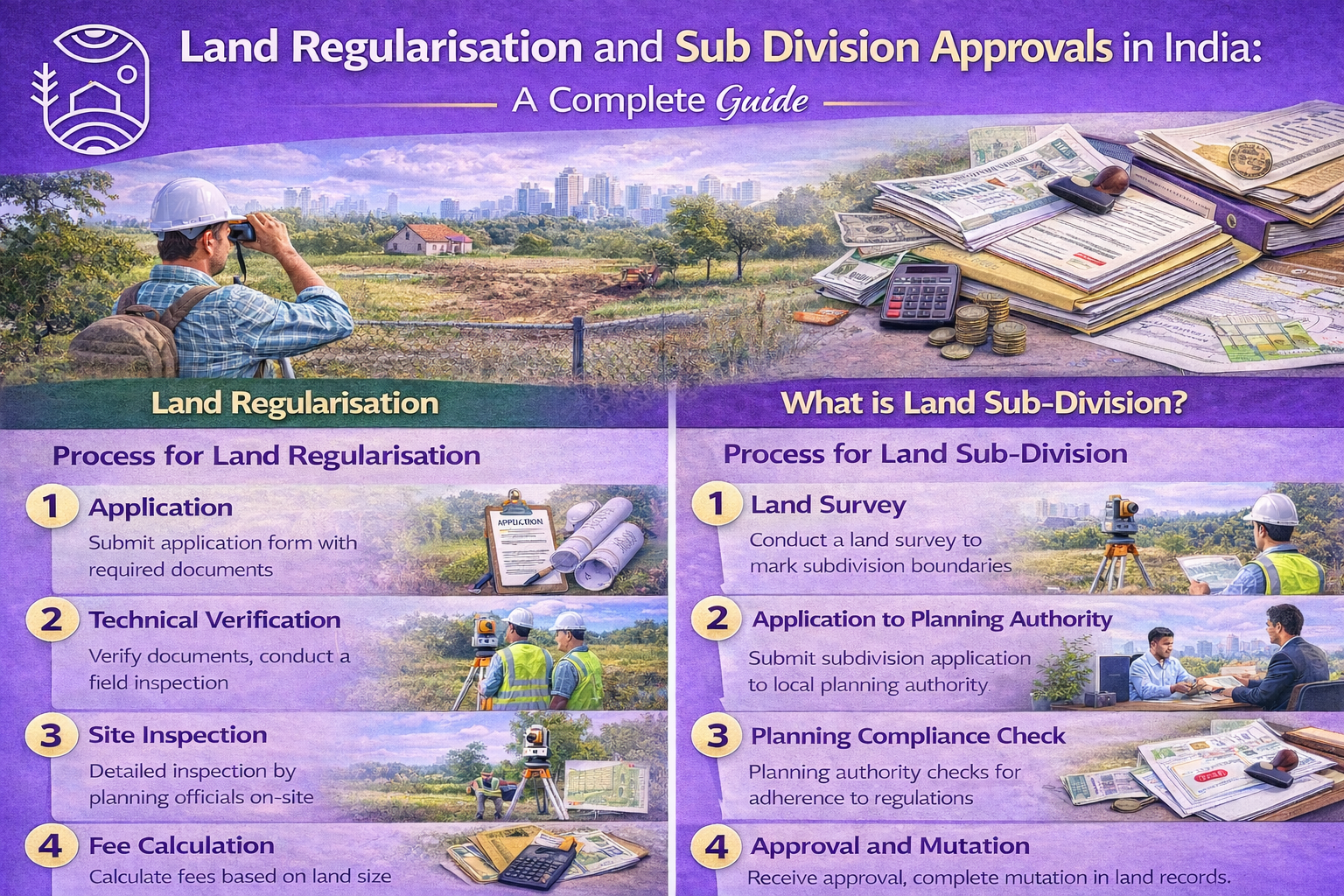
Land Regularisation and Sub-Division Approvals in India: A Complete Guide
Land regularisation and sub-division approvals are important for legal land development in India.
They help landowners bring land records, usage, and planning status into proper legal compliance.
This guide explains the process, eligibility, required documents, and why these approvals matter.
1. What is Land Regularisation?
Land regularisation is the legal process by which unauthorised land use, layouts, or constructions are made lawful by the government after payment of penalties and compliance with planning norms.
It usually applies to:
- ✅ Unapproved layouts or plotting
- ✅ Illegal sub-division of land
- ✅ Construction without planning approval
- ✅ Encroachments on government land
- ✅ Use of agricultural land for residential or commercial purposes without conversion
Many states introduce special regularisation schemes to bring illegal developments into the formal planning system.
Why Governments Regularise Land
Regularisation helps governments:
- ✅ Bring illegal developments into legal records
- ✅ Improve tax collection
- ✅ Enable infrastructure planning such as roads, drainage, and utilities
- ✅ Protect buyers who unknowingly purchased unapproved plots
Authorities Responsible for Approval
Approvals depend on whether the land is located in an urban or rural area.
Urban Areas
Authorities may include:
- ✅ Development Authorities
- ✅ Municipal Corporations
- ✅ Metropolitan Development Authorities
- ✅ Local Planning Authorities
Examples include:
- ✅ Bangalore Development Authority
- ✅ Chennai Metropolitan Development Authority
- ✅ Delhi Development Authority
Rural Areas
Authorities may include:
- ✅ District Collector
- ✅ Tahsildar
- ✅ Town and Country Planning Department
- ✅ Gram Panchayat
Step-by-Step Process for Land Regularisation
Step 1 – Application
The first step is to submit an application to the relevant authority.
This may include:
- ✅ Local planning authority
- ✅ Development authority
- ✅ Municipal corporation
Documents required may include:
- ✅ Title deed
- ✅ Survey sketch
- ✅ Encumbrance certificate
- ✅ Property tax receipts
- ✅ Layout plan
Step 2 – Technical Verification
Authorities verify important technical details such as:
- ✅ Survey number
- ✅ Land use zoning
- ✅ Road access
- ✅ Plot dimensions
- ✅ Environmental restrictions
Step 3 – Site Inspection
Officials then inspect the site to verify the actual condition of the property.
This usually includes checking:
- ✅ Plot boundaries
- ✅ Encroachments
- ✅ Road access
- ✅ Actual land use
Step 4 – Fee Calculation
After verification, the applicable fees are calculated.
These may include:
- ✅ Regularisation charges
- ✅ Infrastructure charges
- ✅ Penalty fees
2. What is Land Sub-Division?
Sub-division means splitting a single land parcel into smaller plots.
This is common when:
- ✅ Landowners develop layouts
- ✅ Family property is divided
- ✅ Developers create housing plots
Sub-division is legal only if approved by the competent planning authority.
Otherwise, it becomes an unauthorised layout.
Example
A plot measuring 10,000 sq. ft can be divided into 4 plots of 2,500 sq. ft each.
Process for Sub-Division Approval
Step 1 – Land Survey
A licensed surveyor prepares a sub-division sketch.
Step 2 – Application to Planning Authority
The application should be submitted with:
- ✅ Existing title documents
- ✅ Survey map
- ✅ Proposed plot division
Step 3 – Planning Compliance Check
The authority verifies whether the proposed sub-division meets planning requirements.
This includes checking:
- ✅ Minimum plot size
- ✅ Road access
- ✅ Zoning compliance
Sub-division is generally allowed only if the plot is within an approved layout and meets planning standards.
Step 4 – Approval and Mutation
After approval:
- ✅ New plot numbers are created
- ✅ Land records are updated
Key Documents Required
Important documents typically include:
- ✅ Mother deed (title chain)
- ✅ Sale deed
- ✅ Encumbrance certificate
- ✅ Land survey sketch
- ✅ Record of Rights, Patta, or Khata
- ✅ Property tax receipts
Key Takeaway
Land regularisation and sub-division approvals are essential for legal land development in India.
Without these approvals:
- ✅ Plots may be illegal
- ✅ Registration may be blocked
- ✅ Infrastructure may never be provided
Why Worry When Nilam Is There?
Nilam provides end-to-end support for landowners by ensuring that all land-related matters are handled professionally and securely.
Upon entering into a proper service agreement with the client, Nilam collects and maintains copies of all relevant land documents for record and processing purposes.
With this authorization in place, Nilam can efficiently manage and coordinate all activities related to land maintenance, documentation, compliance, and approvals.
This includes liaising with relevant authorities, monitoring the status of applications, ensuring regulatory compliance, and overseeing routine land management.