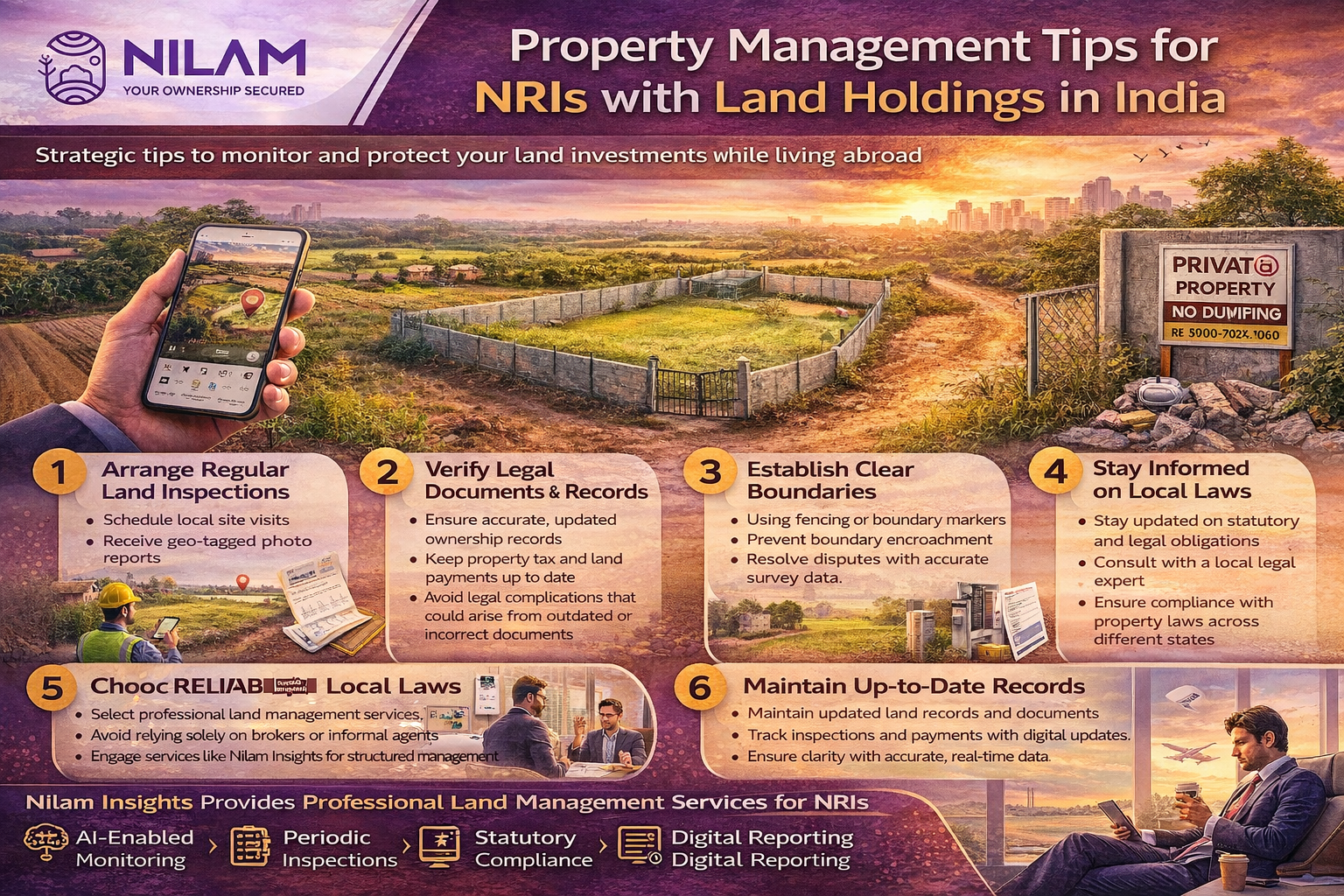
Property Management Tips for NRIs with Land Holdings in India
Managing land in India, especially vacant plots or agricultural land, is very different from managing apartment property. Land is more vulnerable to disputes, encroachment and legal complications, so it requires a more preventive and control-focused strategy.
For Non-Resident Indians (NRIs), managing land in India presents a unique challenge because ownership alone does not guarantee control, especially when the owner is physically absent for most of the year. Many NRIs visit India only briefly during vacations, and during this limited time, property-related matters often take a back seat to family and personal commitments. As a result, regular oversight of land becomes inconsistent or neglected.
However, in the Indian context, land that appears unattended can quickly attract unwanted attention. Local observers such as neighbours, brokers or opportunistic encroachers often identify patterns and can easily distinguish between actively managed properties and those that are rarely visited. This makes absentee-owned land particularly vulnerable.
Why Regular Monitoring Matters
Regular monitoring plays a crucial role not just in maintaining the physical condition of the land but in creating what can be called visible ownership. When land is inspected periodically, cleaned or maintained, it sends a strong signal to the surrounding community that the property is under active supervision. This perception alone can deter encroachment, unauthorized use or boundary disputes.
In many cases, illegal occupation does not begin as a major intrusion. It starts gradually through small acts such as dumping materials, temporary cultivation or minor extensions by neighbouring properties. Without timely intervention, these small encroachments can evolve into complex legal disputes that are difficult and time-consuming to resolve.
Regular monitoring helps identify such issues early, allowing for swift action and reducing long-term risk. Since NRIs cannot be physically present at all times, the key is to create a system that ensures continuous oversight despite the distance.
Practical Property Management Tips for NRIs
- Arrange regular site inspections
- Maintain geo-tagged photo and video records
- Keep the land clean and visibly maintained
- Verify boundaries and survey details periodically
- Install fencing or visible boundary markers where needed
- Track land tax, property tax and statutory payments on time
- Keep ownership and mutation records updated
- Use structured reporting for all site visits and actions taken
Legal and Administrative Challenges for NRIs
Another important challenge for NRIs holding land in India is their limited familiarity with the local legal and administrative systems. Unlike residents who interact regularly with government processes, NRIs often find it difficult to keep track of statutory obligations such as payment of land revenue, property tax or compliance with local regulations.
These obligations may vary significantly from state to state, and the procedures involved, whether through online portals or physical offices, can be complex, time-consuming and sometimes unclear. As a result, payments may get delayed or missed altogether, not out of negligence but due to lack of awareness or difficulty in navigating the system from abroad.
Delays in fulfilling these statutory obligations can have serious consequences. Unpaid property taxes or land revenue can attract penalties, interest or even legal notices from local authorities. In some cases, long-term non-compliance may weaken the owner’s position in disputes or create complications during sale or transfer of the land.
Additionally, incomplete or outdated records, such as failure to update mutation or ownership details, can lead to discrepancies in government records, which may later be exploited in legal or ownership conflicts. For NRIs, these risks are heightened because they may not receive timely notifications or may not fully understand the implications of procedural lapses.
To address this, it is essential for NRIs to establish a reliable system for managing legal and statutory responsibilities.
Why Choosing the Right Local Support Is Critical
Engaging a local professional to manage land in India is indeed one of the most effective ways to address the challenges faced by NRIs. However, it is equally important to recognize that not all local help is reliable or structured.
Relying on an ordinary broker or informal local agent can sometimes create more risk than security. Such individuals may lack accountability, operate without formal agreements and in some cases may even tamper with records, misrepresent the status of the land or act in their own interest. For an NRI who is already managing property from a distance, this lack of transparency and control can lead to serious legal and financial complications.
The Advantage of Professional Land Management Services
This is where the need for a professional, process-driven land management service becomes critical. A structured organization like Nilam Insights addresses these concerns by offering a systematic and legally compliant approach to land management. Instead of informal arrangements, the engagement begins with a proper service agreement, clearly defining the scope of work, responsibilities and accountability.
This ensures that the relationship is transparent and legally enforceable, giving the NRI peace of mind.
One of the key differentiators in such professional services is the integration of technology-driven monitoring systems. With an AI-enabled approach, land is not just visited occasionally but is tracked and documented in a consistent and verifiable manner. This includes geo-tagged photographic records, periodic inspection reports and digital documentation, all of which are shared with the landowner.
These records serve two important purposes. They keep the owner informed in real time, and they also act as evidence of active ownership and maintenance in case of any disputes.
How Nilam Insights Supports NRIs
In addition to monitoring, professional services like Nilam Insights typically offer a comprehensive range of land management solutions. These may include regular site inspections, boundary verification, coordination for fencing or maintenance work, assistance with statutory payments such as land tax or property tax and support in maintaining up-to-date legal records.
By handling both operational and compliance-related tasks, they reduce the burden on NRIs who may not be familiar with local procedures or may not have the time to manage them.
Another significant advantage is accountability and documentation. Every activity, whether it is a site visit, maintenance task or legal update, is recorded and communicated systematically. This level of transparency is rarely available with informal agents and is crucial for NRIs who depend entirely on remote updates. It ensures that there is no ambiguity about what is being done, when it is being done and what the current status of the land is.
Conclusion
For NRIs, professional and structured land management not only protects their property but also allows them to manage their land as a truly long-term and reliable asset without the constant stress of physical absence.
In India, land that looks unattended becomes vulnerable. Land that looks actively managed stays better protected. For NRIs, the most effective strategy is to combine regular monitoring, legal compliance and professional support so that ownership is backed by real control.