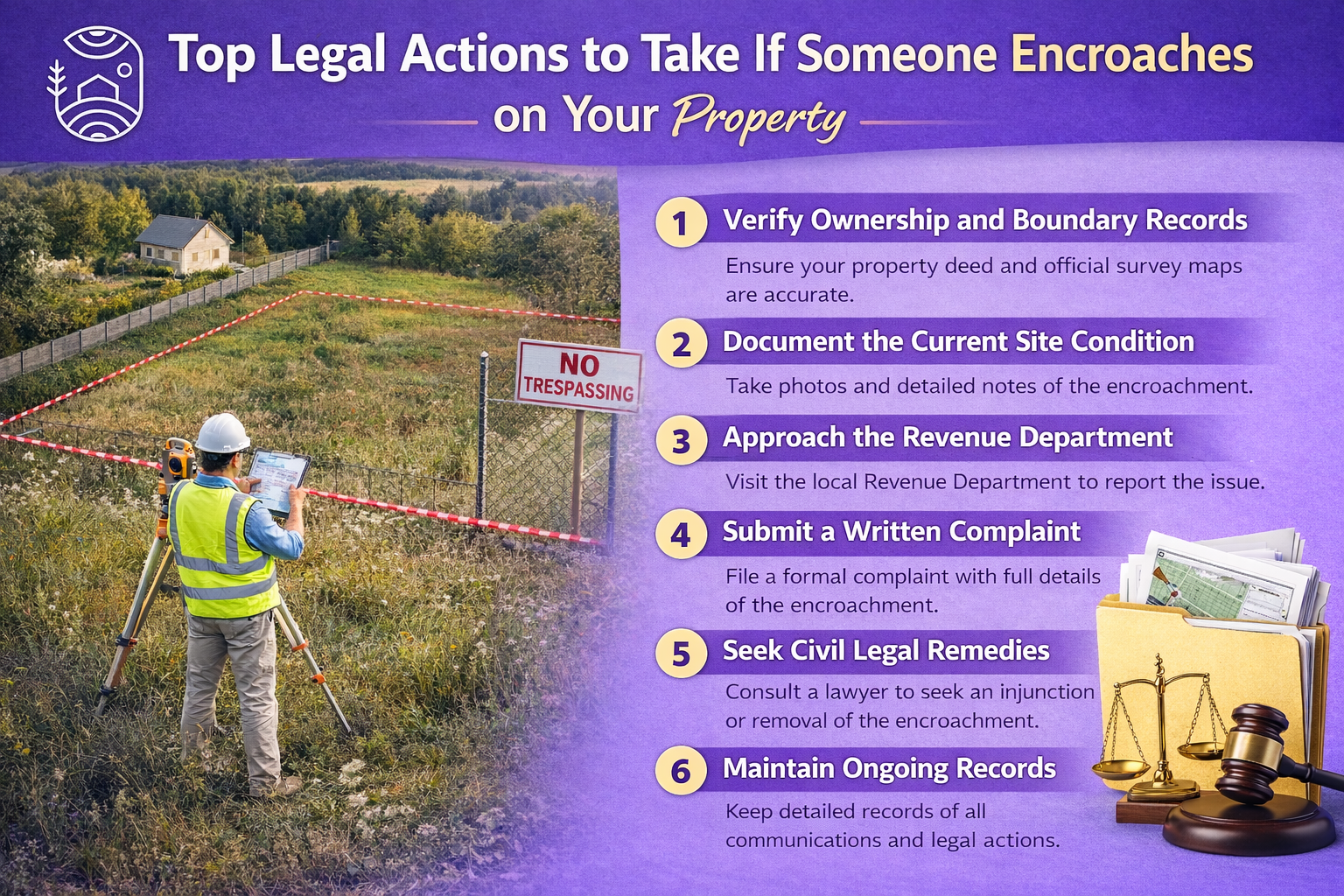
Top Legal Actions to Take If Someone Encroaches on Your Property
Discovering unauthorized use of your property can be concerning.
Responding in a calm, lawful, and well-documented manner helps protect ownership and supports effective resolution.
This article outlines the key legal actions landowners can consider if encroachment is identified.
1. Verify Ownership and Boundary Records
Before taking any formal action, review and organize all relevant documents carefully.
These may include:
- ✅ Title deed
- ✅ Patta or ownership records
- ✅ Survey sketches and field measurement records
- ✅ Previous inspection photographs
Clear documentation forms the foundation for any legal or administrative step.
Without proper records, it becomes difficult to establish ownership and boundary position clearly.
2. Document the Current Site Condition
After reviewing your records, the next step is to document the current condition of the site.
This can be done through a site visit or inspection.
During the inspection, make sure to:
- ✅ Record photographs and videos
- ✅ Note visible changes or unauthorized usage
- ✅ Identify affected boundary points
Dated visual records help establish timelines and support clarity during proceedings.
They also help show the actual ground situation if the matter needs official review later.
3. Approach the Revenue Department
Landowners may approach the appropriate revenue authorities for support with verification and records clarification.
This may include:
- ✅ Village Administrative Officer (VAO)
- ✅ Revenue Inspector
- ✅ Tahsildar
These offices can assist with boundary verification, records clarification, and issuing notices where required.
Approaching the correct authority at an early stage can help avoid delay and confusion.
4. Submit a Written Complaint
A written complaint is an important step in starting an official review process.
The complaint should clearly mention:
- ✅ Property details
- ✅ Nature of unauthorized use
- ✅ Supporting documents
It is always recommended to keep copies of all submissions for future reference.
Written records help maintain a proper trail of action and communication.
5. Seek Civil Legal Remedies
If the issue continues or requires stronger legal intervention, landowners may approach civil courts.
Depending on the situation, the court process may involve:
- ✅ Temporary injunctions to prevent further unauthorized use
- ✅ Permanent injunctions to protect boundaries
A legal professional can guide the process based on the available documents and the actual site condition.
This step is important when official complaints alone are not enough to protect the property.
6. Maintain Ongoing Records
Even after legal or administrative action begins, record keeping should continue without interruption.
This includes:
- ✅ Periodic inspections
- ✅ Updating photographic evidence
- ✅ Maintaining communication records
Consistent documentation supports smoother follow-up and strengthens the case over time.
Ongoing records also help landowners stay informed about changes happening on the property.
Why Timely and Structured Action Matters
Legal remedies work best when combined with clear records, timely action, and responsible follow-through.
Early and well-documented steps help resolve matters more efficiently and lawfully.
When the situation is handled in an organized way, landowners are in a better position to protect their rights and make informed decisions.
How Nilam Insights Supports Landowners
All the above information is useful for understanding the concept.
However, when it comes to actually focusing on the matter and implementing it independently, many landowners face confusion about where to begin, whom to approach, and how to carry out each step effectively.
This is where Nilam Insights steps in with a systematic and professional approach.
Nilam Insights handles activities efficiently and seamlessly by supporting landowners through structured documentation, site visibility, and clear reporting.
This reduces the need for clients to visit multiple places for their land maintenance needs and helps them make informed decisions whenever required.